
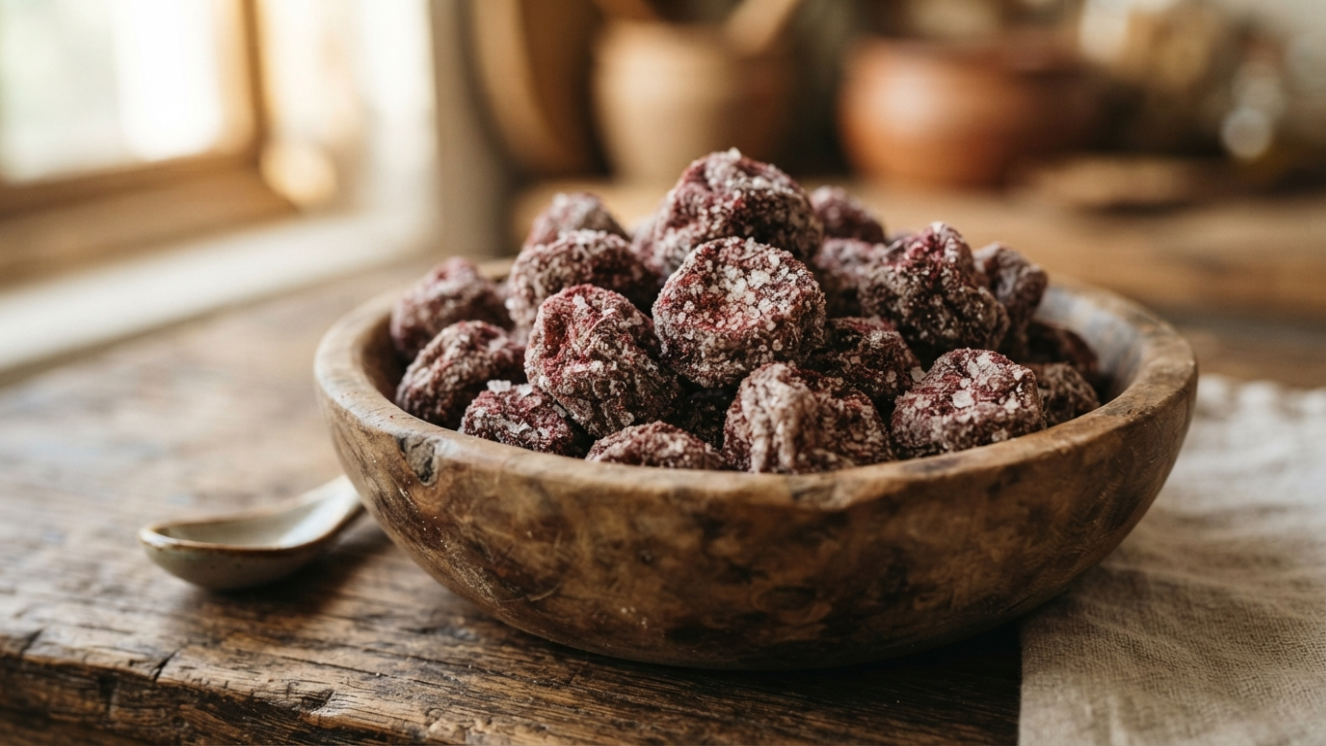
Walk past any school gate, sari-sari store, or old downtown market in the Philippines and you'll spot it eventually: a jar or plastic tub of small, wrinkled, reddish-brown fruit, dusted in a powder somewhere between rust and coral. Ask the vendor what it is, and depending on where you are, you might hear kiamoy, kiamuy, or simply "kiam-kiam yan" — that's the salty one. It's a throwaway phrase, but it holds centuries of migration, trade, and appetite inside it.
Before it was a snack, kiam was just an adjective. In Hokkien — the language spoken by the Chinese immigrants who settled across the Philippines from the Spanish colonial period onward — kiam (鹹) simply means "salty." Say it twice, kiam-kiam, and in the sing-song redundancy so common in Hokkien-derived Filipino slang, you get an emphasis: properly, deeply, unmistakably salty. It's the same linguistic instinct that gave Filipino-Chinese food words like kiampong ("salty rice," a glutinous rice dish) and kikiam (the pork-and-shrimp roll many Filipinos have never realized is a "salty" word too).So when someone calls a snack kiam-kiam, they're not naming a specific product. They're describing a whole sensory category — the salted, preserved, intensely flavored treats that Chinese immigrants brought with them and that Filipino taste buds eventually made their own.
The clearest descendant of that word is kiamoy — arguably the most recognizable "salty plum" in Philippine snack culture. It traces back to a Chinese treat called li hing mui (旅行梅), sour dried plums preserved in brine, sometimes called huamei (話梅) elsewhere in China. When Chinese immigrants — many of them Hokkien-speaking traders and settlers — arrived in the Philippines, they brought the technique and the taste with them.What emerged locally took on its own identity. Kiamoy is made from dried sour plums, prunes, or apricots, cured in brine and vinegar, then rolled in a powder called kiam-muy-hoon — literally "salted plum powder" — a mix of salt, sugar, and anise (sometimes licorice), along with a red li hing powder made from ground plum seeds. The result is a candy the color of rust or dried blood, and a flavor that hits sour, salty, and sweet almost simultaneously — an assault on the palate that, somehow, people can't stop returning to.Mexicans have something similar in saladitos, and many Filipinos who've tried both will tell you kiamoy simply hits harder — more layered, more aggressively flavored. It's most often sold from street carts near schools and public markets, tucked in small plastic packets, and it has a folk reputation as a remedy for car sickness and nausea — the kind of home wisdom passed down without anyone quite explaining the mechanism.
Kiamoy doesn't stand alone. Philippine-Chinese food culture is full of kiam words, each one carrying the same root idea of salt as flavor and preservation:Champoy (also tsampóy or sampóy) — a Bicol regional cousin, made from the local Myrica rubra berry instead of plum, darker in color and sweeter and more tart than kiamoy's straightforward saltiness. Over time, the name has stretched to also cover sweetened tamarind candies.Kiampong — glutinous rice cooked with pork, Chinese sausage, and vegetables in a soy-vinegar sauce; its name translates directly to "salty rice."Kikiam — the fried, five-spice-seasoned pork roll wrapped in beancurd skin, a beloved streetfood staple whose name may also trace back to that same kiam root, tangled up with Hokkien words for meat and rice topping.None of these dishes look alike. One is candy, one is a rice casserole, one is fried street food. But trace the etymology back far enough, and they all share a linguistic ancestor: a word for salt that Chinese-Filipino communities folded into the everyday vocabulary of Philippine eating.
It's tempting to treat kiamoy and its relatives as a footnote — a quirky snack sold in small packets. But the salty-sour-sweet profile they carry says something bigger about how Filipino food developed. Chinese immigrants didn't just open restaurants; they married into local families, ran the neighborhood stores, and slowly wove their pantry into everyone else's. Salt-cured, vinegar-brined, sugar-dusted fruit is a preservation technique built for a tropical climate without refrigeration — practical first, delicious as a bonus.Centuries later, the practicality is gone, but the craving remains. A kid buying a packet of kiamoy outside a Manila elementary school isn't thinking about migration history or Hokkien phonology. They just know: this is the salty one. The kiam-kiam. And that one small word, repeated for emphasis, is still doing the same job it did generations ago — telling you exactly what you're about to taste.